The Softer Hours: What Happens at Yuguang After the Crowd Thins
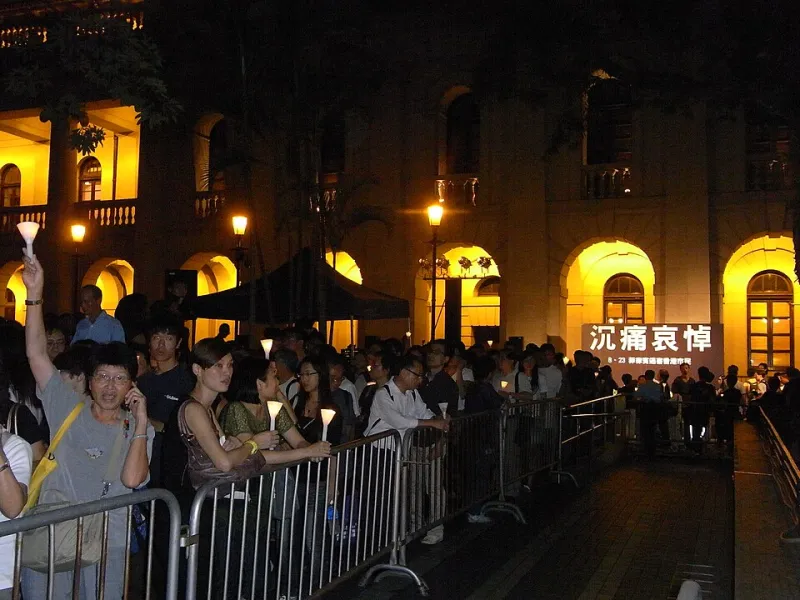
Photo: Maethanim, CC BY-SA 3.0, via Wikimedia Commons
The Festival Changes Register
By 10:45 p.m., the broad walkways of Yuguang Art Festival have lost their daytime rhythm. The stroller traffic has thinned. The queue for the most photographed installation is gone. What remains is a different festival: quieter at the edges, odder in the middle, and more willing to let silence sit between people.
Call it the softer hours. Festival staff do not market them as a separate event, but they describe a reliable shift in behavior once the evening's headline crowds move toward the exits. Visitors walk slower. Artists step out from behind their booths. Strangers ask questions that would have felt too earnest at 7 p.m.
'During the day, people are managing the festival,' said Lena Ortiz, a light sculptor whose suspended installation anchors the eastern lawn. 'At night, they stop managing it and start noticing it. They ask me what I meant. They tell me what it reminded them of. Sometimes they just stand there.'
The Crowd Thins, the Conversation Deepens
The change is partly logistical. Fewer bodies mean shorter waits, clearer sightlines, and less competition for the best vantage point. But the effect is also social. In a dense crowd, visitors perform attention: they pose, narrate, and move on. In a sparse one, attention becomes more private—and often more honest.
Dana Whitfield, a high school art teacher from Boise, Idaho, said she planned to leave Yuguang by 9:30 p.m. but stayed past midnight after a conversation with a ceramicist she had never met. 'I sat down on a bench because my feet hurt,' she said. 'The artist was packing up her display, and she asked if I had noticed the shadows on the pavement from her pieces. I had not. We talked for maybe forty minutes. It was the best part of the festival.'
That kind of encounter is not accidental. Yuguang's site plan keeps several installations open later than the main vendor rows, creating pockets of low-density space where conversation can begin without a crowd pressing in. The festival's operations team also slows its cleaning and security sweeps in those areas, avoiding the abrupt signals that usually tell visitors to leave.
Marcus Bell, a festival operations coordinator, said the late shift requires a different kind of planning. 'Earlier in the evening, we are managing flow,' he said. 'Later, we are managing permission. People need to feel that it is still okay to be here, that they are not keeping anyone from going home.'
Artists Stop Performing and Start Explaining
For artists, the late hours offer something rarer than foot traffic: unscripted feedback. Many exhibitors spend the day repeating a compact version of their practice—materials, influences, price points. After 11 p.m., the pitch loosens.
Ortiz said she often learns more about her own work from late-night visitors than from daytime compliments. 'Someone told me last year that the piece felt like a held breath,' she said. 'I had never thought of it that way. Now I cannot unsee it.'
That exchange is not purely sentimental. Artists described the late shift as useful for testing new work, observing how people move through an installation when they are tired and less guarded, and hearing the questions that do not fit into a standard booth conversation. The festival's creative team has begun taking notes on those interactions for future programming, though staff emphasized that the late hours are not a focus group.
The Rules of the Late Shift
The softer hours are not for everyone. Visitors with young children, early shifts, or long drives often make the sensible choice to leave earlier. The festival does not encourage anyone to push past fatigue. But for those considering a longer stay, a few patterns are worth knowing.
First, the late hours reward a single anchor. Visitors who try to see everything after 11 p.m. tend to hurry; visitors who choose one installation and return to it a second time tend to linger. Second, the best conversations often happen at the edges of the site, not at the center. Third, the temperature drops. A layer that felt unnecessary at sunset becomes useful by midnight.
'Do not treat the last hour as a bonus round,' Bell said. 'Treat it as its own visit. The festival is different then. You should be different too.'
Should You Stay?
For visitors deciding whether to remain, the practical answer depends on transit, stamina, and temperament. Yuguang publishes its final shuttle times and closing announcements at the information pavilions; visitors should check those before committing to a late stay. The festival also keeps lighting along the perimeter routes consistent after dark, a small design choice that makes the walk back to transit feel less like an afterthought.
The less practical answer is that the late hours offer a version of Yuguang that cannot be scheduled. The art does not change. The crowd does. The conversations do. And for a festival built around the meeting of light and art, that quieter, stranger, more candid hour may be where the meeting becomes most visible.