After the Lights Go Down: How Creating for Yuguang Permanently Reshapes an Artist's Practice
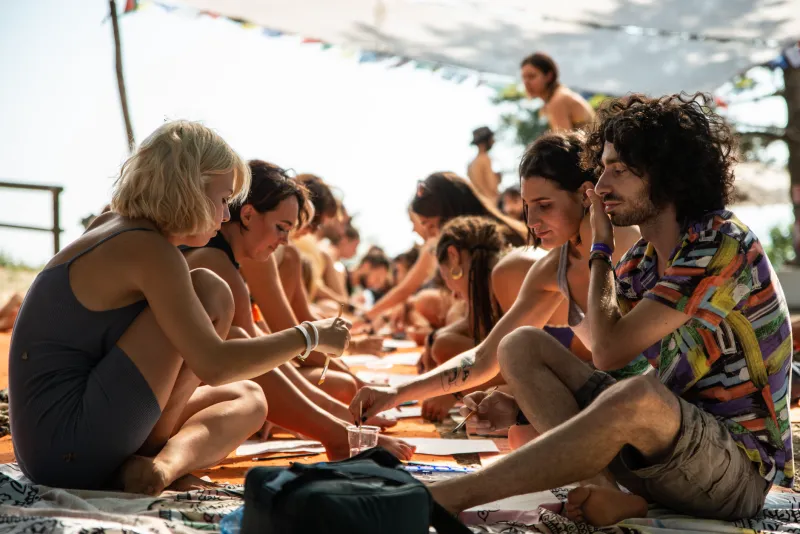
There is a particular kind of silence that descends on an artist after a major festival closes. The crowds have gone home. The installations have been dismantled. The collaborative energy that filled every hour of production week has dissipated back into ordinary life. And yet, for many of the artists who have created work for the Yuguang Art Festival, something essential remains—a shift in perspective that refuses to be packed away with the equipment.
What follows is a conversation with several of those artists about what the festival gave them that they never expected to receive: a permanently altered relationship with their own creative practice.
The Audience as Co-Creator
Before her first Yuguang installation, painter and mixed-media artist Celeste Wren had spent the better part of a decade working in relative solitude. Her studio in Asheville, North Carolina was, by her own description, a place of deliberate quiet. "I made work for galleries," she says. "Which meant I made work for white walls and careful lighting and people standing at a respectful distance. I understood that transaction very well."
Her Yuguang commission—a large-scale immersive environment combining projected imagery with hand-painted textile panels—placed her work in an entirely different kind of relationship with its audience. Visitors moved through the installation freely, touching the fabric, casting shadows across the projections, fundamentally altering the visual experience for everyone around them. "The first night I stood inside it and watched people interact with it, I felt something I can only describe as loss of control," Wren admits. "And then, very quickly after that, something that felt like relief."
The experience catalyzed a decisive shift in her post-festival practice. Wren now incorporates participatory elements into nearly all of her gallery work—invitation cards that ask viewers to physically rearrange components of a piece, QR-linked audio that changes based on where in a room a viewer is standing. "Yuguang taught me that the audience isn't an interruption to the artwork," she says. "They're the final material."
Scaling Up, Thinking Bigger
For sculptor and fabricator Jerome Okafor, the festival's influence was less about audience relationship and more about scale—specifically, his willingness to operate at it. Prior to his Yuguang residency, Okafor's work had been confined primarily to gallery-sized pieces, a practical limitation shaped in part by studio space and in part by a quiet fear of overreach.
"There's a kind of self-editing that happens when you work small for long enough," he explains. "You stop imagining large because large feels presumptuous. Like you haven't earned it yet."
The process of designing and building a thirty-foot kinetic light sculpture for Yuguang—working alongside structural engineers and fabrication specialists he'd never have encountered in his usual professional circles—dismantled that self-imposed ceiling. "By the end of production week, I had built something I would have told you was impossible two years earlier. And once you know you can do that, you can't unknow it."
Since the festival, Okafor has accepted two major public art commissions in the United States, both involving large-scale permanent installations. He credits the Yuguang experience with giving him not just the technical confidence to pursue those projects, but the professional vocabulary to communicate his vision to institutional clients. "Festival production teaches you how to talk about your work to engineers, to administrators, to people who are not artists," he says. "That's an underrated skill."
Collaboration as a Creative Method
Perhaps the most commonly reported transformation among Yuguang alumni concerns collaboration itself. Many artists arrive at the festival accustomed to working alone or within small, familiar teams. The festival's production environment—dense with specialists, accelerated by deadlines, and charged with the particular energy of a shared creative mission—introduces them to a mode of working that many subsequently find impossible to abandon.
Interactive media artist Dana Fung describes the shift in almost physical terms. "My studio practice had always been very internal. Very much about protecting the idea until it was ready. At Yuguang, I had to share ideas that were half-formed, sometimes quarter-formed, with people I'd just met. And something better came out of that exposure than anything I would have produced alone."
Fung has since restructured her practice to include what she calls "open development periods"—stretches of time during which she invites collaborators from outside the art world, including architects, musicians, and data scientists, to participate in early-stage creative conversations. "Yuguang showed me that the best ideas don't live in one person's head. They live in the space between people."
The Temporary as Teacher
There is something philosophically instructive, several artists note, about making work that is explicitly designed to disappear. Festival installations are temporary by definition—built to be experienced intensely and then dismantled. For artists accustomed to thinking in terms of permanence, legacy, and archival longevity, this can be a quietly radical reorientation.
"I used to think about every piece in terms of where it would end up," says Wren. "A collection, a permanent installation, a museum. Yuguang made me think about the experience itself as the destination. The work doesn't have to outlast the moment to matter."
This shift toward what might be called experiential rather than object-based thinking has led several Yuguang alumni to experiment with performance, ephemeral installation, and community-based practices that leave little or no physical residue. The festival, in other words, has not simply influenced how these artists make things—it has influenced what they believe art is for.
A Community That Persists
Beyond the individual transformations, a striking number of Yuguang alumni describe the festival as the origin point of ongoing professional communities. Collaborations forged during production week have evolved into long-term partnerships, shared studios, and co-founded organizations. The intensity of the festival environment, it seems, accelerates the kind of trust that typically takes years to build.
"I met three of my closest collaborators at Yuguang," says Okafor. "People I now talk to every week, whose opinions I trust more than almost anyone else in my field. That network came directly from the festival."
For the Yuguang Art Festival, this ripple effect—the ways in which a single, temporary creative event continues to generate value long after its closing night—represents something more than a measure of success. It is evidence of a particular kind of cultural investment, one that treats artists not merely as content providers but as practitioners whose growth, risk-taking, and community-building constitute a form of shared cultural wealth.
The lights come down. But what they illuminate, it turns out, has a much longer life.