After Midnight, Whose Sky Is It? Yuguang's Neighbor Problem, in Full Glow
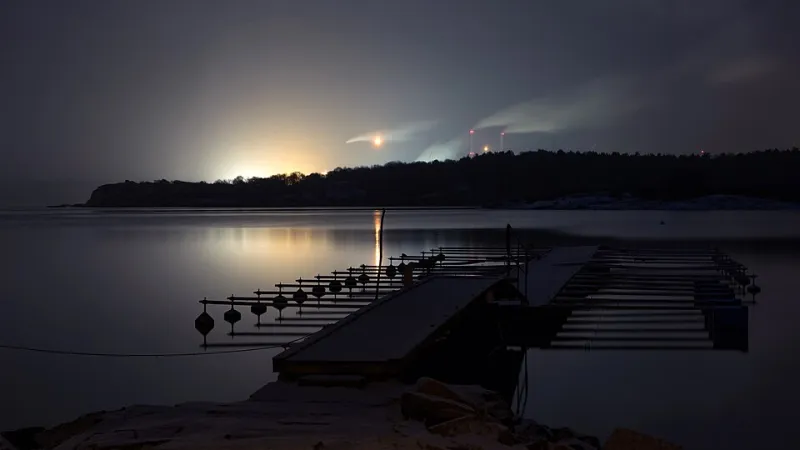
Photo: W.carter, CC0, via Wikimedia Commons
From the roof of a parking garage three blocks from the Yuguang Art Festival, the 2026 edition looks less like a collection of installations and more like a low, luminous weather system. The glow rises from the fairgrounds, catches the underside of clouds, and spills into the streets beyond the perimeter. It is beautiful from a distance. It is also light that did not ask permission from the people living nearby.
This is the tension at the heart of any nighttime festival. Spectacle depends on brightness. Neighborhood peace depends on restraint. Yuguang has spent years refining the first. It now needs to spend more time on the second. The question is not whether the festival should glow. It is whether it can glow boldly without glowing rudely.
The geography of glow
Light trespass is the technical term for light that falls where it is not wanted. At Yuguang, trespass comes from several sources: floodlights aimed at tall installations, unshielded fixtures along walkways, illuminated signage, and the cumulative skyglow produced by thousands of small sources. Individually, each may seem minor. Together, they create a halo that extends well beyond the festival footprint.
Measurements taken during the 2026 festival by a local environmental group found that illuminance at the edge of a nearby residential block exceeded typical urban background levels by a significant margin on peak nights. The group did not call for the festival to close. It called for a conversation. That conversation is overdue.
What neighbors actually notice
Neighbors rarely complain about the art itself. They complain about the light in their bedrooms. They complain about the glow that makes it hard to sleep at 1 a.m. They complain about pets that pace during the loudest and brightest hours. They complain about the feeling of being adjacent to an event they did not choose and cannot opt out of.
Festival organizers have responded with a community hotline, a limited number of complimentary tickets, and a liaison who attends neighborhood meetings. Those are good gestures. They are not a design strategy. A hotline can document a problem, but it cannot shield a window.
Wildlife after dark
Light at night is not only a human nuisance. It disrupts insects, birds, bats, and other species that rely on darkness for navigation, feeding, and rest. Migratory birds are especially vulnerable. They can be drawn off course by artificial light, especially during fall and spring migration. Insects swarm around unshielded fixtures and die of exhaustion. Bats alter their foraging routes to avoid illuminated corridors.
The 2026 festival fell during a period of active migration. Organizers say they are aware of the issue and have begun consulting with local wildlife experts. That is a start. But awareness is not the same as mitigation. A festival that celebrates light has a special responsibility to understand what light does to the nonhuman world.
The fixture-level fixes
Much of the solution is engineering, not abstinence. Shielded fixtures direct light downward and onto the intended subject rather than into the sky. Cutoff optics reduce glare at the source. Timers and dimming schedules allow installations to transition to a lower-output mode after a certain hour. Directional aiming keeps floodlights on the artwork and off nearby windows. Warm color temperatures can reduce ecological disruption compared with cool white light, though no artificial light at night is ecologically neutral.
These are not exotic technologies. They are standard tools in responsible lighting design. The challenge is applying them consistently across a festival with dozens of independent artists and contractors. That requires a lighting policy, not just good intentions.
Community agreements
Yuguang could adopt a good-neighbor agreement with surrounding residents and businesses. The agreement would set expectations for peak brightness, after-hours dimming, complaint response, and annual review. It would include a resident liaison with authority to flag problems in real time. It would publish a simple map of light-sensitive zones and a schedule of late-night programming.
Community agreements work best when they are negotiated, not announced. The festival should invite neighbors to the table before the next edition, not after the first complaint. It should also compensate residents for disruption in ways that go beyond tickets. That could mean funding blackout curtains for affected homes, supporting neighborhood lighting retrofits, or contributing to local wildlife monitoring.
The harder question: can spectacle be quiet?
The most interesting design challenge is not how to make the festival darker. It is how to make darkness intentional. Some of the most memorable moments at Yuguang already come from contrast: a darkened path that opens onto a bright installation, a low-lit seating area that lets the sky become part of the show. Contrast is a design tool. Uniform brightness is not.
A festival that understands contrast can afford to be quieter after midnight. It can let some installations rest. It can turn off decorative signage while keeping the art illuminated. It can treat the night sky as a collaborator rather than an empty canvas. That is not a retreat from spectacle. It is a more sophisticated version of it.
A 2026 pilot and a 2027 promise
Yuguang should pilot a Midnight Mode in 2027 on the perimeter of the festival grounds. The pilot would use shielded fixtures, dimming schedules, and directional aiming on a selected group of installations. It would monitor light levels at nearby residences and gather feedback from residents and wildlife experts. The results would inform a permanent lighting policy.
The festival has already proven that it can make wonder at scale. The next proof is harder. It is the proof that wonder can be a good neighbor. After midnight, the sky belongs to everyone. Yuguang should act like it.