No Velvet Rope: How Immersive Art Festivals Dissolve the Hierarchies That Divide Us
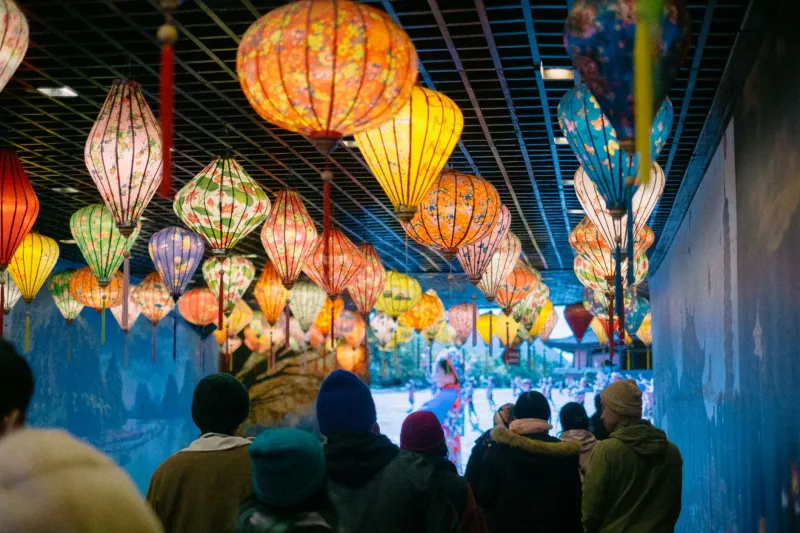
America has always been a nation of gatherings. From town halls to tailgates, from Broadway opening nights to county fairs, the country organizes itself into shared spaces with remarkable regularity. Yet if you look closely at almost any of those spaces, the same invisible architecture reasserts itself: who paid more, who arrived with the right connections, who fits the unspoken demographic profile of the room. The velvet rope may not always be physical, but it is almost always present.
Immersive art festivals occupy a rare and genuinely different position in this landscape. At events like the Yuguang Art Festival, something quietly extraordinary happens when thousands of strangers from different zip codes, different tax brackets, and different political persuasions converge around light, sound, and large-scale installation art. The usual sorting mechanisms of American public life — price signals, dress codes, social capital — lose much of their force. What remains is something closer to a genuine commons.
The Unusual Arithmetic of Awe
Sociologists have long noted that shared emotional experiences have a leveling effect on social groups. When people encounter something genuinely astonishing — a sudden storm, a piece of music that stops a crowd mid-conversation, a light installation that renders language temporarily inadequate — the cognitive resources normally devoted to social comparison get redirected. You are, for a moment, simply a person in the presence of something larger than yourself.
This is not a trivial observation. Most American leisure spaces are stratified by design. A concert venue separates floor from balcony. A museum separates the gala from the public opening. A sporting event separates the luxury suite from the upper deck. These distinctions are not incidental; they are revenue models. They communicate, continuously and legibly, where you stand relative to everyone else.
An immersive art festival organized around light and spatial experience resists that logic in practical ways. Installations do not have a best seat. A sculpture that responds to the movement of visitors rewards curiosity, not currency. A light corridor that transforms as you walk through it offers the same transformation to the retired schoolteacher from rural Ohio and the venture capitalist from San Francisco. The work itself is indifferent to your biography.
What Shared Darkness Actually Does
There is something specifically democratizing about the conditions that define light-based art festivals. When the ambient light drops and an installation takes hold of the visual field, the usual social cues — clothing, posture, the subtle semiotics of affluence — become harder to read. People stand closer together than they ordinarily would. They make eye contact with strangers. They comment aloud to no one in particular and find that someone answers.
At Yuguang, this phenomenon plays out across the festival grounds with a consistency that longtime attendees remark upon with genuine surprise. A grandmother and a college student standing before the same shimmering canopy of projected light are, in that moment, having the same experience. Not a similar experience. The same one. That convergence is rarer in American public life than we tend to acknowledge.
Cultural critic bell hooks once described the radical potential of spaces where people "come together across difference." She was not writing about art festivals, but the observation applies. The gathering itself — not the art, not the programming, but the simple fact of diverse strangers choosing to occupy the same space for a shared purpose — constitutes a kind of civic act.
The Political Unconscious of the Festival Ground
It would be naive to suggest that art festivals have solved the problems of inequality that structure American life. Ticket prices matter. Transportation access matters. The geography of where festivals are held matters enormously, and the art world has its own well-documented hierarchies of prestige and exclusion. These are real constraints, and the Yuguang Art Festival, like any ambitious cultural institution, continues to grapple with them through community programming, scholarship initiatives, and partnerships with local organizations.
But the experience on the ground, once people arrive, operates by a different logic than most American institutions. There is no product being sold in the conventional sense. You cannot upgrade your relationship to the art by spending more money once you are inside. The festival does not reward the loudest voice or the most recognizable name. It rewards presence, attention, and a willingness to be moved.
In a political climate defined by sorting — by the tendency of Americans to increasingly inhabit separate information environments, separate neighborhoods, and separate versions of reality — this matters more than it might appear. Shared physical experience in the presence of genuine beauty is not a policy solution. But it is a reminder that the divisions we navigate daily are, to some meaningful degree, constructed. They can be, at least temporarily, otherwise.
A Different Kind of Public Space
The great American public spaces — the national parks, the public libraries, the free municipal museums — have always carried an implicit democratic promise. The Yuguang Art Festival belongs to a newer tradition, one that uses art, light, and designed experience to create something that functions like a public square: a place where the primary activity is not consumption but encounter.
What distinguishes this kind of space is its invitation. It asks nothing of you except attention. It does not require that you have read the right books, hold the right opinions, or belong to the right community. It asks only that you show up and look. In a country where so much of public life has become a performance of identity and affiliation, that simplicity is, paradoxically, radical.
Wonder, it turns out, is not a luxury. It is one of the few experiences that Americans of every background still reach for with equal hunger. Festivals like Yuguang do not manufacture that hunger. They simply create the conditions under which it can be fed — equally, openly, and without a velvet rope in sight.