Invisible Architecture: The Spatial Intelligence Behind Yuguang's Most Unforgettable Moments
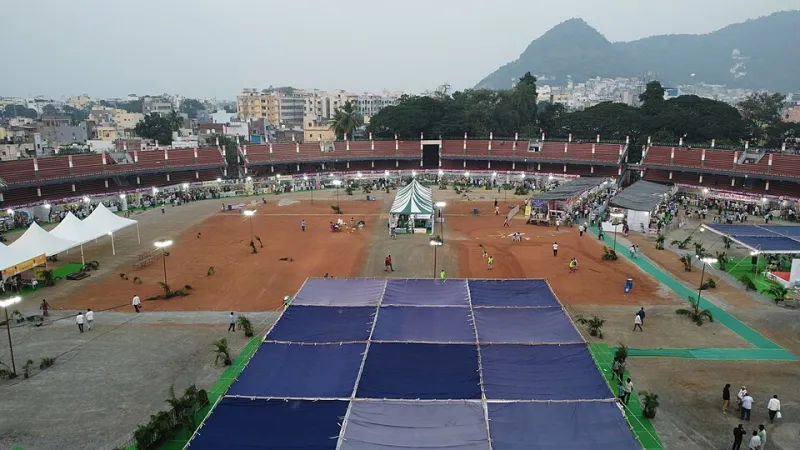
Photo: Saiphani02, CC BY 4.0, via Wikimedia Commons
Ask most Yuguang visitors to describe what made the festival extraordinary, and they will reach for the expected vocabulary: the installations, the light, the scale, the surprise. Rarely does anyone say: the path between the parking area and the first gate. Or: the deliberate narrowing of the walkway before the central field. Or: the fact that the largest installation on the grounds is never visible until you are already deep inside the venue.
And yet these invisible decisions — made long before the first artist unpacks a single fixture — may be the most consequential design choices of the entire event.
"People think the festival is the art," says James Okafor, a spatial designer who has collaborated with Yuguang's production team for the past four years. "The festival is the frame. And the frame determines almost everything about how the art is received."
The First Impression Is Never the First Impression
Effective festival design, Okafor explains, begins well before the entrance gate. The approach — the transition zone between the everyday world and the festival environment — is itself a designed experience, even when it does not feel like one. "We think about what people are leaving behind," he says. "They're coming from a parking lot, or a shuttle, or a walk through a neighborhood. They're still carrying their day. Our job, starting from the moment they can see the festival perimeter, is to begin the process of displacement."
This displacement is achieved through a carefully managed sequence of sensory cues: a gradual increase in ambient light, the introduction of sound at a threshold just below the level of conscious attention, and the use of transitional architecture — covered walkways, low-lit corridors, gates framed to create a sense of threshold — that signals to the nervous system that something different is about to begin.
Environmental psychologist Dr. Renata Solis, whose research at Stanford focuses on how built environments influence emotional states, describes this as "priming the perceptual system." "The brain is constantly predicting what comes next," she explains. "Good spatial design manipulates those predictions — sometimes confirming them, sometimes violating them — to create specific emotional effects. The best festival designers are doing applied environmental psychology, whether or not they use that language."
The Grammar of Pathways
Once inside the festival grounds, the network of pathways becomes the primary tool of emotional orchestration. At Yuguang, these routes are never simply the most efficient way to move between points. They are sequences — composed with the same intentionality as a piece of music — designed to modulate the visitor's energy and attention across the duration of the experience.
Width is among the most powerful variables. Broad pathways encourage social movement: conversation, group dynamics, a diffuse sense of festivity. Narrower passages create intimacy and focus, directing attention inward and preparing the visitor for an encounter that demands deeper presence. Yuguang's design team uses these modulations deliberately, widening the thoroughfares near food and social areas and tightening the approaches to its most immersive installations.
"We want people to slow down before they enter something significant," says Okafor. "A wide-open approach lets visitors arrive at speed, still in social mode. A constricted path forces a kind of decompression. By the time they step inside, they're already in a different state."
The Strategic Use of Nothing
Perhaps the most counterintuitive tool in the festival designer's kit is negative space — the deliberate use of open, relatively unadorned areas between major installations. In an environment where the impulse is always to fill every corner with spectacle, the decision to leave space empty is a disciplined act of restraint with significant psychological consequences.
Negative space serves multiple functions simultaneously. It allows the nervous system to reset between high-intensity encounters, preventing what Solis describes as "sensory saturation" — the point at which the brain, overwhelmed by continuous stimulus, begins to process everything as undifferentiated background. It also creates contrast, making the subsequent installation feel more vivid and arresting by comparison.
"We call it the exhale," says Okafor. "Every sequence of intense experiences needs an exhale. Without it, everything flattens. The extraordinary becomes ordinary because there's nothing ordinary to measure it against."
At Yuguang, these exhale zones are often among the most carefully designed spaces on the grounds — open enough to feel genuinely spacious, but subtly shaped by lighting, planting, and surface texture to maintain the festival's aesthetic register without demanding active attention.
Sight Lines and the Architecture of Anticipation
The relationship between what visitors can see and what remains hidden is another primary instrument of emotional design. Yuguang's venue layout is organized around a principle of controlled revelation: major installations are positioned and screened so that they are never fully visible from a distance. You cannot survey the festival from its entrance and see everything at once. Discovery must be earned through movement.
This is not accidental. Research in environmental psychology consistently shows that anticipated revelation — the partial glimpse, the hint of something beyond the next turn — generates a state of motivated curiosity that significantly enhances the quality of the eventual encounter. "We are wired to move toward incomplete information," says Solis. "When you can see just enough to know something remarkable is ahead but not enough to know exactly what it is, your brain enters a state of heightened engagement that colors everything you subsequently experience."
Yuguang's designers engineer these sight lines with precision, using temporary structures, plantings, and the natural topography of the venue to create a sequence of partial views that sustain anticipation across the full arc of the festival visit.
The Experience After the Experience
The spatial intelligence of Yuguang extends even to the exit — a dimension of festival design that is almost universally neglected. The transition back to the ordinary world, if handled carelessly, can feel abrupt and deflating, undoing much of the emotional work of the preceding hours.
At Yuguang, the departure route is designed as a gradual decompression: a sequence of lower-intensity spaces, softer light, and quieter sound that eases visitors back toward the everyday rather than depositing them there without ceremony. "We want people to carry something out with them," says Okafor. "Not just a memory, but a feeling. The exit is the last thing we design, and we take it just as seriously as the entrance."
For the millions of Americans who will encounter immersive art festivals in the years ahead, that invisible care — the architecture of the approach, the grammar of the path, the strategic emptiness, the engineered anticipation — is what separates a collection of impressive objects from a genuinely transformative experience. At Yuguang, the design of wonder is itself a form of art.