When Strangers Build Something Together: The Accidental Collaborations Born Inside Yuguang
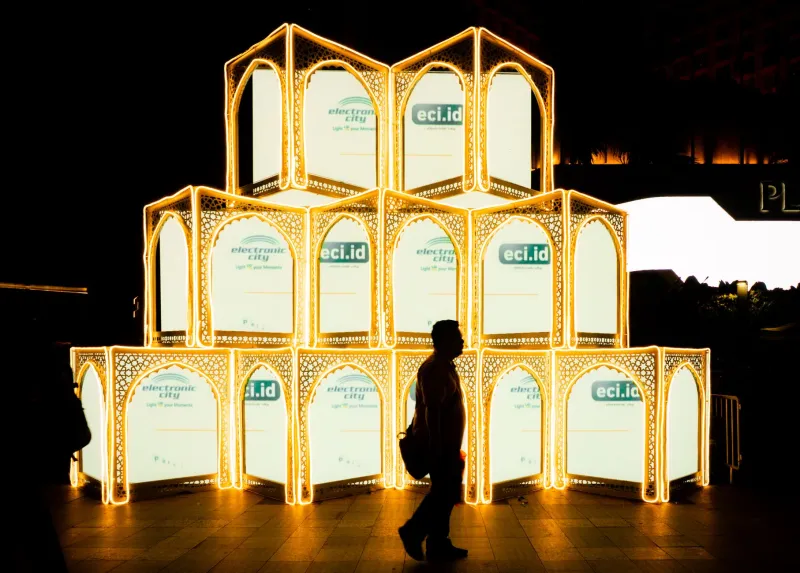
There is a particular moment that many Yuguang Art Festival visitors describe in nearly identical terms. They are standing inside an installation — perhaps adjusting a hanging element, perhaps leaning in to study a luminous surface — when someone beside them does the same thing, and the two movements combine into something neither person intended. A shared laugh follows. Then a conversation. Then, sometimes, a business card.
It sounds almost too neat to be true. Yet the pattern repeats itself with remarkable consistency across every edition of the festival, suggesting that what appears to be serendipity is, in fact, the product of deliberate design.
Architecture as Social Infrastructure
Most traditional gallery environments are engineered for solitude. White walls, enforced silence, and the implicit understanding that one is there to observe rather than participate create a social atmosphere that discourages spontaneous interaction. Yuguang's curatorial philosophy inverts that model entirely.
"We think of every spatial decision as a social decision," says one of the festival's lead spatial designers, who has been involved in the event's layout since its early years. "Where we place a threshold, how wide we make a corridor, whether a room has a center point or a perimeter — all of those choices affect whether people naturally drift toward each other or away from each other."
The result is a layout that functions less like a conventional exhibition and more like what urban planners call a "third place" — a social environment distinct from home and work where informal community-building happens organically. Broad gathering nodes punctuate the festival grounds at regular intervals, each one designed to slow visitors down and encourage them to linger. Installations with interactive components are positioned at these nodes with particular intention.
The Role of Shared Uncertainty
Interactive art, by its nature, creates a kind of productive confusion. When visitors encounter a piece that requires physical input — a wall of pressure-sensitive panels, a floor that responds to collective weight, a soundscape shaped by the movements of everyone in the room — the instinct is often to look around and see what others are doing. That glance is frequently the beginning of a conversation.
"I had absolutely no idea what I was supposed to do," recalls Marcus T., a graphic designer from Portland, Oregon, who attended the festival last year. "I was just kind of hovering near this one piece, watching the light shift, and the woman next to me said, 'I think we have to move at the same time.' We spent twenty minutes figuring it out together. Turns out she ran a small creative studio in Seattle. We've been on two calls since then about a potential project."
This quality — shared uncertainty resolving into shared discovery — appears to be a particularly potent catalyst for connection. Unlike environments where expertise signals status, interactive installations place every visitor on roughly equal footing. No one has the right answer. Everyone is experimenting. That leveling effect lowers social barriers in ways that more passive art experiences rarely achieve.
When Artists Become Part of the Equation
The festival's practice of stationing artists within or near their own installations adds another layer to this dynamic. Rather than retreating to a green room or remaining invisible behind their work, many of Yuguang's participating artists choose to be present on the festival floor, watching audiences engage with their pieces in real time.
For artist Delia Fonseca, whose light-weaving installation drew significant attention at a recent edition, that presence led to an unexpected creative pivot. "A visitor — a textile designer from Chicago — started describing what she was seeing in terms of weaving patterns," Fonseca explains. "She was essentially reading my light work through a completely different vocabulary. I found it so fascinating that we ended up talking for almost an hour. She's now consulting on my next piece."
These artist-visitor encounters blur the boundary between creator and audience in ways that align directly with Yuguang's broader mission. The festival has long maintained that immersive art is not a spectator sport, and the physical proximity of artists to their work makes that philosophy tangible.
Spaces Designed for Conversation
Not every productive encounter happens inside an installation. Some of the most consistently reported connection points at Yuguang are the transitional spaces between major works — the corridors, rest areas, and outdoor gathering zones that many festivals treat as logistical afterthoughts.
At Yuguang, these in-between spaces are treated as programmatic opportunities. Seating is arranged in configurations that invite face-to-face interaction rather than the side-by-side rows common in waiting areas. Ambient soundscapes in transitional zones are calibrated to encourage conversation rather than contemplation. Even the lighting in corridors is designed to feel warm and social rather than purely navigational.
"The spaces between the art are where a lot of the real magic happens," observes Jamie Okonkwo, a community arts organizer from Atlanta who has attended the festival for three consecutive years. "You come out of an installation feeling something, and you need to process it. If the space around you makes it easy to turn to a stranger and say, 'Did you feel that?' — you will."
From Festival Floor to Real-World Partnership
The collaborations that emerge from Yuguang take many forms. Some are professional: designers connecting with photographers, musicians finding visual artists to collaborate with on multimedia projects, small-business owners discovering creative consultants. Others are more personal: friendships formed across geographic and demographic lines that would rarely intersect in everyday American life.
What makes these connections durable, according to those who have experienced them, is the quality of the shared experience that initiated them. Meeting someone at a networking event or a professional conference creates a transactional foundation. Meeting someone inside a space where both parties were emotionally open, aesthetically engaged, and genuinely surprised by the same thing creates something harder to define — and, apparently, harder to forget.
Yuguang's design team has begun documenting these outcomes more systematically, collecting stories from attendees about connections made on the festival grounds that extended beyond a single evening. The archive, still in its early stages, already reflects a striking geographic range: partnerships and friendships formed between visitors from across the country, united briefly by a festival in a single location and sustained afterward by the memory of what they built together, however briefly, in the light.