Hands in the Light: How Festival Workshops Are Turning Everyday Americans Into Artists
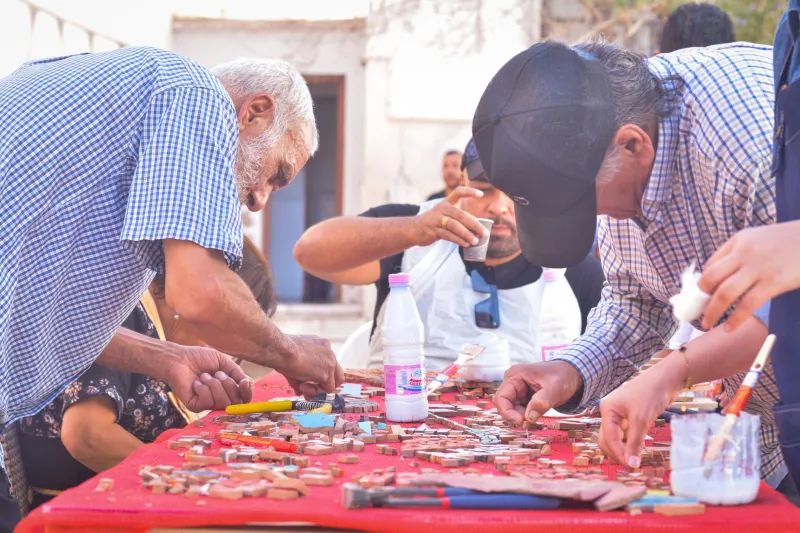
Denise Calloway had never held a paintbrush with any serious intention. A middle school math teacher from Raleigh, North Carolina, she attended the Yuguang Art Festival two summers ago at the mild insistence of her college-age daughter. She expected to watch. She did not expect to make.
But tucked between two large-scale light installations was a workshop tent where a local artist was guiding visitors through the process of creating small luminescent panels using translucent pigments and UV-reactive materials. Denise sat down. She stayed for two hours. By the end, she had produced something she describes, without embarrassment, as "the most honest thing I have ever made."
She has not stopped making since.
Denise's story is not unusual. Across the American festival landscape, a quiet but significant transformation is underway—one that is fundamentally redefining what it means to attend an art event. The passive audience is giving way to the active participant, and the implications for how creative culture is understood, accessed, and owned in this country are considerable.
The Architecture of Participation
For decades, the dominant model of art engagement in the United States was essentially one-directional: trained artists produced work, institutions displayed it, and the public consumed it from a respectful distance. The implicit message, reinforced by hushed gallery spaces and velvet ropes, was that art was something that happened to you—not something you did.
Immersive festivals have systematically dismantled this architecture. At Yuguang, participation is not an afterthought or a supplementary programming element—it is embedded in the festival's foundational philosophy. The belief that art comes alive most fully when it is shared, touched, responded to, and co-created shapes everything from the design of individual installations to the curation of the workshop program.
This year's festival featured more than forty hands-on workshops spanning disciplines including light painting, collaborative mosaic construction, sound composition, textile dyeing, and large-format projection mapping. Crucially, none required prior experience. The only prerequisite was curiosity.
"We design every workshop around the assumption that the person walking in has never done this before," says festival programming coordinator Simone Beauchamp. "That is not a limitation—it is the whole point. The most interesting creative decisions often come from people who don't yet know what they're 'supposed' to do."
Amateur Hour, Redefined
The word "amateur" carries a cultural stigma in the United States that it does not entirely deserve. Etymologically, it derives from the Latin amator—one who loves. An amateur is, at root, someone who creates for the love of it rather than for professional obligation or financial reward. Festivals like Yuguang are rehabilitating this definition in real time.
Jordan Tillman, a 28-year-old warehouse logistics coordinator from Columbus, Ohio, discovered a talent for large-scale collaborative painting at a festival workshop three years ago. He had no formal training, no art school background, and no particular expectation of finding a creative practice. What he found instead was a six-foot collaborative canvas, a set of industrial rollers, and an invitation to contribute.
"There were maybe thirty of us working on this thing at the same time," he recalls. "Nobody was in charge. It just... emerged. And when it was done, it was genuinely beautiful. I remember thinking: I was part of making that. I have never felt that way about anything I've done at work."
Tillman now runs a community mural project in his neighborhood and has been invited to present work at two regional festivals. His trajectory—from workshop participant to emerging public artist—is becoming a recognizable arc within the festival ecosystem.
Blurring the Line: Collaborative Installations
Beyond individual workshops, many of the most compelling participatory experiences at Yuguang are woven directly into the festival's major installations. Several of this year's featured works were designed explicitly as open canvases—structures that evolved and changed in response to visitor contributions over the course of the event.
One installation, conceived by Chicago-based artist collective Resonant Forms, invited visitors to attach hand-written phrases, small photographs, and hand-dyed fabric squares to an expanding framework of illuminated wire. By the festival's final evening, what had begun as a sparse geometric structure had become a dense, glowing archive of thousands of individual voices. The work was simultaneously the artist's creation and the community's.
"We gave it a skeleton," said collective member Asha Brennan. "The visitors gave it a soul."
This model of co-authorship challenges long-standing assumptions about artistic ownership and expertise. It asks: who gets to be called an artist? And it answers, implicitly but unmistakably: anyone who shows up and makes something real.
What Festivals Offer That Schools Cannot
Art education in American public schools has faced decades of budget cuts and curricular marginalization. The National Endowment for the Arts has documented a persistent decline in arts instruction access, particularly in lower-income school districts. For millions of Americans, the creative education they never received in childhood is simply absent from their lives.
Festivals are filling this gap in ways that formal institutions often cannot. The learning environment is low-stakes, socially comfortable, and entirely voluntary—conditions that research consistently identifies as optimal for creative risk-taking. There are no grades, no critiques, no gatekeepers. There is only the work and the experience of making it.
For adults who carry residual shame about their perceived lack of artistic ability—a shame frequently traced back to a single dismissive comment from a childhood teacher—the festival workshop can function as a genuine act of reclamation.
"I was told in fifth grade that I had no talent," says Denise Calloway, the math teacher from Raleigh. "I believed that for thirty years. It took a stranger in a tent at a light festival to show me that wasn't true."
The Ripple Effect
The democratization of creative expression at festivals is not confined to the event itself. Participants carry their experiences home—into community centers, school classrooms, neighborhood organizations, and living rooms. The skills, confidence, and creative identity cultivated in a festival workshop have a social half-life that extends far beyond the closing night.
At Yuguang, this ripple effect is understood as central to the festival's cultural mission. The goal is not only to present extraordinary art to the public, but to expand the public's understanding of what art is, who makes it, and—most importantly—who is allowed to try. In a nation hungry for creative connection and increasingly skeptical of institutional gatekeeping, that mission has never felt more timely.