Mentorship in Motion: How the Festival Floor Becomes a Launchpad for the Next Generation of Artists
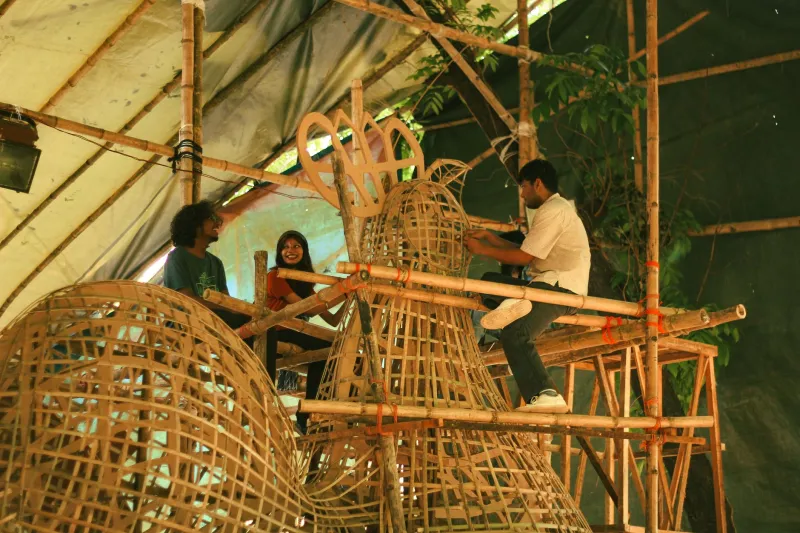
There is a particular kind of electricity that moves through the grounds of Yuguang Art Festival after sundown. The light installations pulse, the crowds shift and murmur, and somewhere between two installations — perhaps in the narrow corridor between a towering projection piece and a hand-built neon sculpture — a conversation begins that will change someone's life.
This is not hyperbole. It is the lived experience of dozens of artists who have passed through the festival's orbit over recent years, many of them arriving as curious unknowns and departing with commissions, collaborators, and clarity about the kind of work they were meant to make.
Yuguang Art Festival has always positioned itself at the intersection of spectacle and substance. But increasingly, its most enduring contribution may not be the installations themselves — it may be the human infrastructure that forms around them.
The Architecture of Opportunity
Large-scale art festivals occupy a unique position in the American cultural landscape. Unlike gallery openings or museum exhibitions, they are inherently democratic spaces. Entry points are accessible. The audience is broad. And the sheer scale of the environment encourages a kind of wandering — both physical and intellectual — that institutional settings rarely permit.
For established artists, this openness creates something genuinely rare: unscripted access to emerging talent.
"I've had more meaningful conversations about craft at festivals than I have in most academic settings," says one light sculptor whose work has been featured in major installations across the Pacific Northwest. "There's no hierarchy enforced by the space itself. Someone can walk up to you while you're adjusting a rig at two in the morning and say something that completely reframes how you think about what you're doing."
That informality is by design at Yuguang. The festival's programming team has long understood that serendipity, while not entirely predictable, can be cultivated. Shared studio hours, open installation walkthroughs, and artist-led evening discussions create repeated opportunities for the kind of lateral exchange that formal mentorship programs sometimes struggle to manufacture.
Structured Support in an Unstructured Environment
Beyond organic encounter, Yuguang Art Festival has developed several intentional frameworks for connecting professional artists with emerging creators. The festival's Emerging Voices initiative pairs selected early-career artists with established mentors for the duration of the event, offering not just conversation but genuine collaboration — shared installation credits, co-facilitated workshops, and in some cases, co-authored grant applications submitted in the weeks following the festival.
The results have been measurable. Several participants from the program's inaugural cohort have since received commissions from cultural institutions in cities including Chicago, Austin, and Philadelphia. One multimedia artist, who attended Yuguang as an emerging participant after years of working primarily in small community gallery settings, credits the festival with providing the professional visibility that ultimately led to her first major public art contract.
"I didn't come in expecting anything except to learn," she recalls. "What I didn't anticipate was that people would be watching — not in a surveillance way, but in a genuinely curious way. Someone saw how I interacted with the space and the audience, and that observation became an invitation."
This dynamic — being seen not just for finished work but for process, for instinct, for the quality of one's attention — is something that distinguishes festival environments from nearly every other professional context available to early-career artists.
What Established Artists Gain
It would be a mistake to frame this exchange as purely philanthropic. Experienced artists who engage with emerging talent at Yuguang are not simply giving back; they are actively enriching their own practice.
"Working with someone who hasn't yet developed the habits that limit how I think is genuinely useful," explains a Brooklyn-based installation artist whose large-scale light works have been exhibited internationally. "Emerging artists ask questions I've stopped asking. They're not worried about what's been done before. That energy is contagious, and it pushes me."
This reciprocity is part of what makes the mentorship culture at Yuguang feel less like a program and more like an ecosystem. Neither party arrives as a supplicant. Both arrive as contributors to a shared creative environment, and the exchange that results tends to be far richer than any formal curriculum could produce.
The Longer Arc
For the festival itself, investing in this mentorship infrastructure is not incidental to its mission — it is central to it. Yuguang Art Festival exists at the intersection of light and lived experience, and it understands that the most powerful illumination is not always the kind that runs on electricity.
Career trajectories change when the right people encounter each other in the right environment. The festival has positioned itself as a place where those encounters are not left entirely to chance. Through thoughtful programming, an ethos of openness, and a genuine commitment to the creative community it serves, Yuguang continues to function as one of the most consequential launchpads available to American artists working at the frontier of experiential and light-based work.
The installations will change from year to year. The artists who discover each other in their glow may carry what they find there for the rest of their careers.