When the Camera Disappears: The Unexpected Power of Undocumented Art
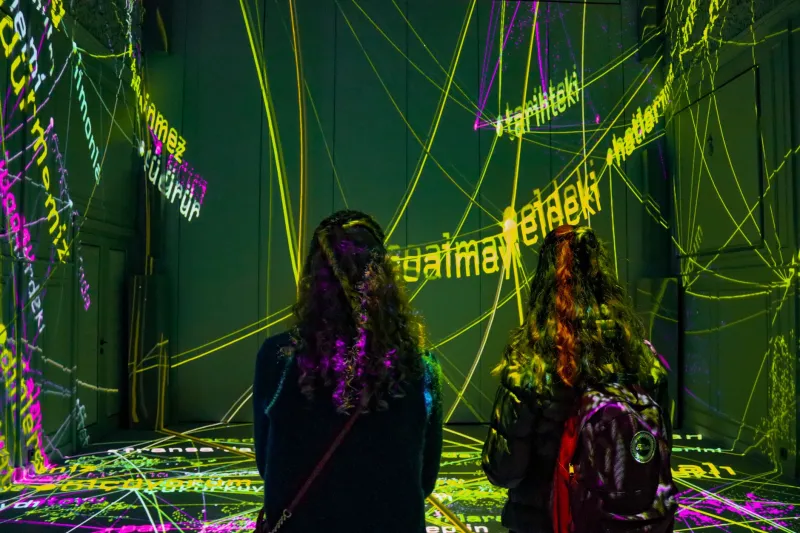
There is a peculiar irony embedded in the culture of contemporary art festivals. The more deliberately an installation is engineered for the social media feed — saturated colors, symmetrical geometry, a perfectly framed selfie opportunity — the more quickly it fades from collective memory. Yet certain works at Yuguang Art Festival, pieces that seem almost allergic to easy documentation, have a habit of circulating online for months after the event closes. They travel not as pristine photographs but as blurry phone captures, breathless text descriptions, and second-hand accounts that begin with the phrase: You really had to be there.
This is not a coincidence. It is, many artists and researchers now argue, a feature rather than a flaw.
The Algorithm and the Artist
The pressure to create shareable content has quietly reshaped how many emerging creators approach the festival environment. Installations are sometimes conceived backward — starting with the imagined screenshot rather than the sensory intention. Color palettes are calibrated to perform well on Instagram's compression algorithms. Scale is determined not by artistic necessity but by what will look impressive in a wide-angle phone shot.
"There's a version of festival art that's essentially a prop," said one installation artist who has exhibited at Yuguang across multiple seasons. "You're building a backdrop, not an experience. And audiences feel that difference even when they can't articulate it."
Social media strategist Renata Osei, who has consulted with cultural institutions across the Northeast, frames the issue in terms of emotional friction. "Content that is immediately legible tends to generate quick engagement — a like, a share, a save," she explained. "But it rarely generates conversation. The works that actually build community online are the ones that leave people with something unresolved. They need to talk about it because they can't fully show it."
What the Brain Remembers
Neuroscience offers a compelling explanation for this dynamic. Research on memory consolidation suggests that experiences requiring active cognitive processing — those that cannot be passively consumed — are encoded more deeply in long-term memory. When an artwork resists easy categorization or straightforward documentation, the brain works harder to integrate it, and that effort strengthens the memory trace.
Dr. Priya Venkataraman, a cognitive neuroscientist whose work focuses on aesthetic experience, describes this as "productive difficulty." In her view, the installations most likely to stay with an audience are those that engage multiple sensory channels simultaneously while withholding complete resolution. "The mind keeps returning to fill in what it couldn't capture," she said. "That's not frustration — that's meaning-making. And meaning-making is inherently social. People want to share what they couldn't fully grasp alone."
This phenomenon plays out visibly at Yuguang. Among the festival's most discussed works in recent years have been pieces that operate in near-darkness, that involve tactile elements impossible to convey in an image, or that unfold slowly over durations longer than most visitors' patience for video. These are not accidentally undocumentable. Many of their creators made deliberate choices to resist the camera's easy translation.
The Documentation Trap
For artists navigating the contemporary festival circuit, the temptation to optimize for visibility is entirely understandable. Algorithmic reach can translate into gallery interest, commission inquiries, and the kind of professional momentum that is otherwise difficult to generate outside major urban centers. Yuguang, with its national audience and substantial digital footprint, represents a meaningful platform for creators who may have limited access to traditional art-world networks.
And yet a growing number of artists who have shown at the festival describe a kind of liberation in choosing to work against documentation. "The first year I exhibited, I spent so much energy thinking about how the piece would photograph," recalled one Chicago-based light artist. "I made it brighter than it needed to be, more symmetrical. It looked great online. But standing inside it, I felt nothing. The second year, I built something I actually wanted to be in. The photos were terrible. And people would not stop talking about it."
This tension — between algorithmic visibility and authentic resonance — is one the Yuguang curatorial team has addressed with increasing directness. Several recent commissions have explicitly encouraged artists to consider what the camera cannot hold, to treat undocumentability not as a limitation but as a medium.
Viral Without the Visual
The mechanics of how undocumented experiences travel online reveal something important about how cultural meaning actually circulates. When an image fails to capture an experience, language fills the gap. Visitors write longer captions, thread-style reflections, and detailed accounts on platforms like Reddit and Substack. These text-heavy formats tend to generate deeper engagement than image posts, attracting audiences already inclined toward thoughtful cultural participation.
"Word-of-mouth has always been the most powerful marketing tool," Osei noted. "Social media hasn't replaced it — it's just given word-of-mouth a longer reach and a searchable archive. When someone writes three paragraphs about why a piece moved them to tears and they can't explain exactly why, that is infinitely more compelling than a perfectly lit photograph."
The implication for festival culture is significant. The works that endure in public conversation — that build the kind of sustained attention that translates into cultural relevance — may be precisely those that refuse to make the camera's job easy.
Presence as Practice
For Yuguang Art Festival, these findings point toward a broader curatorial philosophy: that the most meaningful cultural experiences are those that demand full presence. This does not mean rejecting documentation wholesale, nor does it require artists to treat visibility as suspect. Rather, it suggests that the question worth asking at the inception of any work is not how will this look online but how will this feel to stand inside.
When artists begin from that question, something shifts — in the work itself, in the audience's relationship to it, and ultimately in the way the experience travels beyond the festival grounds. The camera, it turns out, is most powerful when it is forced to admit its own limits.