Spectacle With a Conscience: Inside Yuguang's Commitment to Sustainable Festival Design
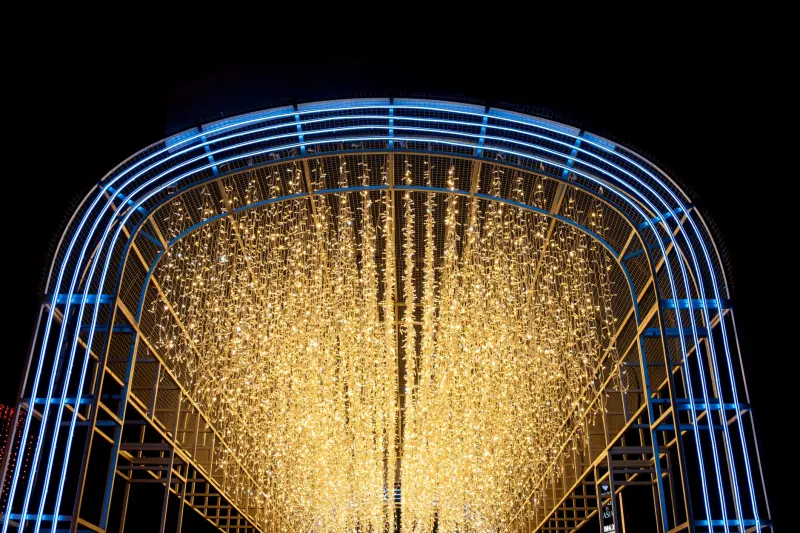
The numbers associated with large-scale light festivals are, at first glance, difficult to reconcile with any serious environmental commitment. Thousands of LED fixtures. Miles of cabling. Structural frameworks assembled from materials that must be transported, erected, and eventually dismantled. Generators running through the night. Crowds of visitors arriving by car, bus, and plane.
How does an event built on illumination avoid becoming a symbol of excess?
At Yuguang Art Festival, this question is not treated as a public relations challenge. It is treated as a design problem — one that the festival's operations team, in collaboration with exhibiting artists and external sustainability consultants, approaches with the same rigor and creativity that artists bring to the work itself.
The LED Revolution and Its Limits
The single most significant shift in festival lighting over the past decade has been the widespread adoption of LED technology. Compared to the halogen and incandescent fixtures that once powered large-scale light events, modern LED systems consume a fraction of the energy while producing equivalent or superior visual output. For Yuguang, transitioning to an all-LED infrastructure was a foundational decision — one that dramatically reduced the festival's baseline energy consumption before any additional measures were considered.
But the team is candid about the limitations of this achievement. LED systems still require electricity, and electricity still has to come from somewhere. In regions where the grid relies heavily on fossil fuels, even highly efficient lighting carries an indirect carbon cost that cannot be dismissed simply because the technology is cleaner than its predecessors.
In response, Yuguang has pursued a multi-pronged energy strategy. Where possible, installations are powered through partnerships with renewable energy providers. Solar generation arrays, where logistically feasible given the festival's location and duration, supplement grid power. Battery storage systems allow energy captured during daylight hours to offset nighttime demand. The goal is not to achieve a zero-footprint — the team acknowledges that this is not currently possible for an event of Yuguang's scale — but to minimize reliance on carbon-intensive power sources and to be transparent about the gap that remains.
"We don't use the word 'sustainable' loosely," noted one member of the festival's operations team during a recent planning session. "It's an aspiration we're genuinely working toward, not a marketing claim. And part of working toward it honestly means being willing to say, publicly, where we fall short."
Structures Built to Return
Beyond energy, the material lifecycle of festival infrastructure presents a significant environmental challenge. The scaffolding, frames, and mounting systems that support large-scale installations must be robust enough to ensure visitor safety while remaining practical to transport, assemble, and disassemble within the compressed timeline of a festival production.
Yuguang has worked with fabricators and structural engineers to develop a modular framework system that prioritizes reuse over single-use construction. Core structural components are designed to be reconfigured across multiple installations and multiple festival seasons rather than fabricated anew each year. Materials that reach the end of their usable life are directed toward recycling streams rather than landfill disposal wherever technically and economically feasible.
Several artists exhibiting at Yuguang have taken this philosophy further, incorporating reclaimed and recycled materials directly into their work. One recent installation used decommissioned fiber-optic cabling salvaged from a telecommunications infrastructure project; another employed hand-formed glass elements blown from recycled cullet. These choices are not merely aesthetic — they represent a deliberate artistic engagement with questions of resource consumption and material value that align closely with the festival's broader environmental commitments.
Waste, Water, and the Visitor Footprint
The environmental impact of a festival is not limited to its physical infrastructure. The behavior of tens of thousands of visitors over the course of a multi-day event generates waste streams, water consumption demands, and transportation emissions that can collectively dwarf the footprint of the installations themselves.
Yuguang has implemented a zero-single-use-plastic policy across all vendor concessions and operational areas, requiring participating food and beverage providers to use compostable or reusable serviceware. Water refill stations are distributed throughout the festival grounds to reduce reliance on bottled water. Waste sorting stations — staffed by trained volunteers who can assist visitors in correctly separating compostable, recyclable, and landfill-bound materials — are positioned at regular intervals.
Transportation remains one of the most complex elements of the visitor footprint equation. The festival actively promotes the use of public transit and coordinated shuttle services, offering incentives for attendees who arrive without a personal vehicle. Carpooling coordination tools are made available through the festival's digital platforms. These measures have produced measurable reductions in single-occupancy vehicle arrivals in recent seasons, though the team is forthright in acknowledging that the majority of visitors still arrive by car — a reality that reflects both the geography of the festival's host communities and the broader limitations of American public transit infrastructure.
The Honest Tension
Perhaps the most intellectually rigorous aspect of Yuguang's approach to sustainability is its willingness to name the central contradiction directly: a festival devoted to spectacular visual experiences will always carry an environmental cost that purely local, small-scale, or digital alternatives would not.
The question the festival's leadership has chosen to engage with is not whether that cost exists — it clearly does — but whether the cultural, social, and community value generated by the event justifies it, and whether that cost can be reduced to a level commensurate with the benefits produced.
"We believe deeply in the value of what this festival does for artists and communities," said one senior member of the Yuguang organizing team. "But we don't think that belief exempts us from accountability. It makes accountability more important, not less. The people who attend this festival, the artists who exhibit here — they deserve to know that we're taking this seriously."
That seriousness is evident in the festival's annual environmental impact report, which is published in full on the Yuguang website and includes unedited data on energy consumption, waste diversion rates, and transportation emissions. The report does not present only favorable metrics. It includes areas where targets were missed and provides specific plans for improvement in the following season.
In an era when environmental claims are frequently deployed as marketing instruments with minimal substantive backing, this degree of transparency is itself a meaningful act. It signals that Yuguang's commitment to ecological responsibility is not a feature of its public image but a genuine operating principle — one that, like the art it presents, is willing to sit with complexity, acknowledge imperfection, and continue reaching toward something better.
The light that defines Yuguang is, at its best, a light that sees clearly. That clarity, the festival's team has decided, must extend to the mirror it holds up to its own practices — and to the honest, ongoing work of making spectacle and conscience genuinely compatible.