From Spectator to Maker: How One Night at Yuguang Can Change What You Do With Your Weekends Forever
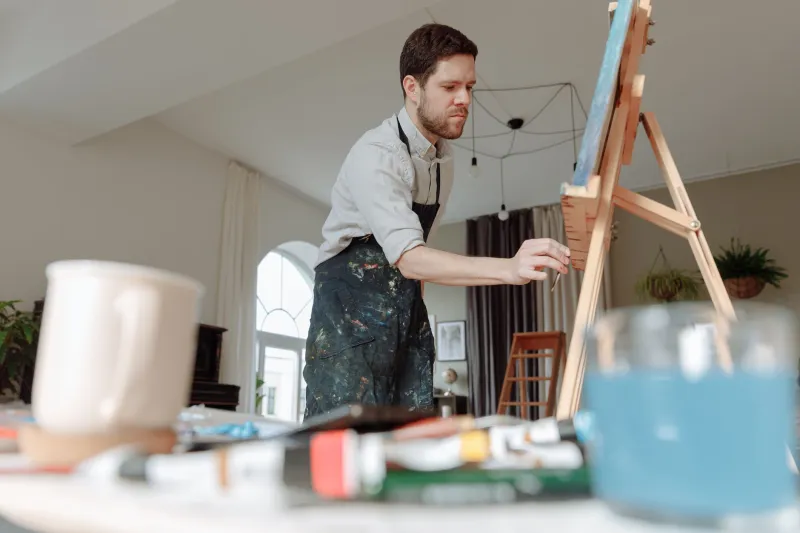
For many Yuguang Art Festival attendees, the experience does not end when the lights fade and the crowd disperses. Months — sometimes years — after their first visit, former spectators find themselves picking up paintbrushes, stringing LED strips across garage ceilings, or rearranging their living rooms into something they can only describe as 'an installation.' What is it about immersive art that converts witnesses into practitioners?
The answer, it turns out, is both deeply personal and remarkably consistent across thousands of visitors.
The Moment Everything Shifts
Ask almost anyone who attended Yuguang and later began a creative practice of their own, and they will point to a single, specific moment. Not a general impression of beauty or wonder, but a precise instant when something inside them quietly rearranged itself.
For Dana Kowalski, a middle school science teacher from Columbus, Ohio, that moment arrived while standing inside a corridor of suspended fiber-optic strands that responded to the movement of visitors passing through. She had brought her two children on a whim, expecting an enjoyable evening and nothing more.
"I watched my daughter reach out and touch one of the strands, and the whole corridor shifted color," she recalls. "It wasn't just that it was beautiful. It was that someone had thought deeply enough about human instinct — about the way we all reach toward light — to build something that rewarded that impulse. I couldn't stop thinking about it for weeks."
Within three months, Dana had enrolled in an evening ceramics class. Within a year, she had transformed a corner of her basement into a dedicated studio space. She credits Yuguang not with teaching her a skill, but with dismantling the assumption that making art was something other people did.
Permission, Not Instruction
This distinction — between acquiring technique and receiving permission — is one that researchers who study creative behavior find particularly significant. Psychologists who examine what they call 'creative self-efficacy' have long noted that many adults carry an internalized narrative that art belongs to the talented, the trained, or the professionally designated. Immersive festivals, by their very nature, challenge that narrative in a way that a gallery visit or a museum tour rarely does.
When art surrounds you — when it responds to your footsteps, shifts with your breath, and exists in the same physical space your body occupies — the boundary between audience and participant dissolves. You are not observing someone else's world from a respectful distance. You are inside it, and it is changing because you are there.
That experience, for many visitors, functions less like education and more like evidence. Evidence that art is not a fixed monument but a living conversation — and that they are already, without any formal credential, part of that conversation.
Ripple Effects Across American Living Rooms
The downstream creative activity inspired by Yuguang takes forms as varied as the festival's own programming. Some visitors begin journaling with a new seriousness after attending. Others start experimenting with photography, ambient music, or home décor that prioritizes mood and atmosphere over conventional aesthetics. A notable number turn to light itself — fairy lights, colored bulbs, and DIY projection setups — as their primary medium of expression.
Marcos Rivera, a logistics coordinator from San Antonio, Texas, had never considered himself remotely artistic before attending Yuguang with a group of coworkers four years ago. He now runs a modest side business designing custom ambient lighting environments for local restaurants and event spaces.
"I kept trying to recreate the feeling of what I'd seen," he explains. "Not to copy it — I knew I couldn't — but to understand how light could make a room feel a certain way. So I started experimenting in my apartment. Then friends started asking me to do theirs. It just grew from there."
His story is not an outlier. Across online communities dedicated to DIY lighting, ambient art, and home installation projects, references to immersive festivals — and to Yuguang specifically — appear with striking regularity as the original catalyst.
What Bold Art Does to Ordinary Doubt
There is a particular quality to the art presented at Yuguang that may amplify its capacity to inspire creative action in viewers. The festival's programming consistently features work that is unambiguously ambitious — large in scale, deliberate in concept, and unafraid of asking something from its audience. This boldness, paradoxically, appears to lower the psychological stakes for observers rather than raise them.
When visitors witness artists operating without apparent apology — committing fully to a vision that might be strange, vulnerable, or technically imperfect in some minor way — it recalibrates their internal standard for what constitutes 'enough' to justify making something. The implicit message absorbed through hours of immersive experience is not 'you must achieve this level of mastery.' It is closer to 'someone cared enough about an idea to build it, and that caring was sufficient.'
For people who have spent years dismissing their own creative impulses as insufficiently polished or professionally viable, that realization can be quietly transformative.
Sustaining the Spark Between Festivals
Yuguang has increasingly recognized that its relationship with attendees does not conclude at the exit gate. The festival's broader cultural mission — to illuminate the intersection of art, community, and lived experience — extends naturally into the creative lives that visitors carry home with them.
Through its online community platforms, Yuguang has begun curating spaces where former attendees can share the creative work they have pursued in the months following the festival. The range of contributions is striking: hand-sewn textile art, backyard light gardens, original musical compositions, short films, and elaborate chalk murals have all appeared alongside brief accounts of the specific festival moments that inspired them.
The cumulative effect is something that resembles a distributed studio — a creative community dispersed across American cities and towns, connected not by geography but by the shared experience of having stood inside something luminous and come away changed.
Art as a Contagion
Perhaps the most honest way to describe what Yuguang does for its visitors is this: it makes creativity feel contagious. Not in the sense that it replicates itself mechanically, but in the way that genuine enthusiasm has always spread — through proximity, through witnessing, through the simple and ancient human impulse to respond to beauty by making more of it.
Dana Kowalski's ceramics now line the windowsills of her Columbus home. Marcos Rivera's lighting installations glow in three San Antonio dining rooms. And somewhere, in apartments and garages and spare bedrooms across the country, people who once stood inside the light are quietly, persistently building worlds of their own.
That may be the festival's most enduring exhibition — the one that never closes and keeps expanding long after the grounds go dark.