Hometown Reimagined: How a Single Night at Yuguang Rewires the Way Visitors See Their Own Streets
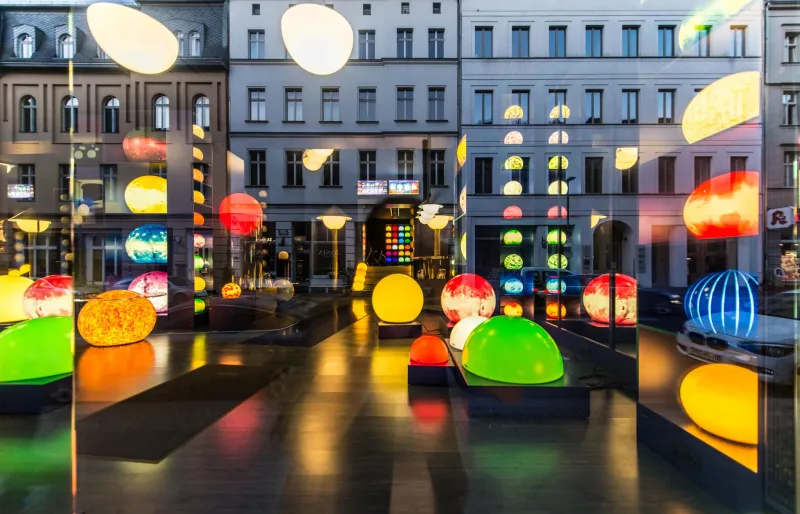
There is a particular moment that many Yuguang Art Festival attendees describe with striking consistency. It arrives not during the festival itself, but days or weeks afterward—standing at a familiar intersection, walking a well-worn path through a neighborhood park, or gazing at a blank municipal wall. Suddenly, that unremarkable surface does not look unremarkable anymore. It looks like a canvas.
This quiet perceptual shift, so difficult to anticipate and so difficult to reverse, has come to define what longtime observers call the "festival effect." It is the phenomenon by which immersive, large-scale art does not merely entertain its audience but fundamentally recalibrates how that audience processes the built environment around them. And at Yuguang, where light itself becomes the medium and public space becomes the stage, the effect appears to be especially pronounced.
Seeing the Familiar as Foreign—Then Seeing It as Possibility
Psychologists who study aesthetic perception have long noted that exposure to heightened visual environments can induce a state of enhanced noticing—a temporary dissolution of what researchers call "perceptual habituation," the mental shortcut by which we stop truly seeing the spaces we inhabit every day. Immersive art festivals, by design, force that habituation to collapse. When every surface is alive with projected light, every shadow deliberate, every pathway curated for emotional effect, the brain recalibrates its baseline for what a public space can be.
For Yuguang visitors, that recalibration does not always reset when they drive home.
Marielle Okonkwo, a landscape architect from Columbus, Ohio, attended the festival for the first time two years ago. She describes walking through one of Yuguang's large-scale light corridors and feeling, for the first time in years, genuinely disoriented by beauty. "I've studied public space professionally for over a decade," she says. "But standing inside that installation, I stopped thinking like a professional and started thinking like a person who had just been reminded that public space is supposed to feel like something."
When she returned to Columbus, she found herself photographing loading docks, underpasses, and empty lots with a new kind of attention. Within six months, she had partnered with a local arts nonprofit to propose a temporary light installation for a neglected pedestrian corridor near her city's convention district. The proposal is currently under review by the city's arts commission.
From Spectator to Steward
What makes Yuguang's ripple effect particularly compelling is how consistently it moves people from passive appreciation to active civic participation. Attendees do not simply return home with pleasant memories. Many return with a sense of responsibility—a feeling that their own communities deserve the same quality of creative ambition they witnessed at the festival.
Derek Santillana, a high school teacher from Albuquerque, New Mexico, attended Yuguang with a group of his students as part of an arts enrichment trip. He had expected the experience to inspire his students. He had not expected it to inspire him.
"One of my students pointed at a piece—this enormous sculpture made of fiber optics that responded to sound—and said, 'Why don't we have anything like this at home?' And I didn't have a good answer," Santillana recalls. "That question followed me back to New Mexico."
Within a year, Santillana had organized a community meeting to discuss public art funding in his school district, connected with two local muralists who had struggled to find institutional support, and helped secure a small grant for a student-led public art project in a neighborhood that had never hosted one. He credits the Yuguang visit as the catalytic moment. "The festival didn't give me new skills," he says. "It gave me new expectations. And once your expectations change, you can't go back."
The Geometry of Unused Space
One of the more unexpected outcomes of the festival effect is the way it reshapes how visitors perceive unused or neglected urban space. Yuguang installations frequently occupy non-traditional venues—industrial sites, open fields, forgotten architectural interiors—and transform them through creative intervention. For many attendees, this serves as a kind of proof of concept: that the overlooked corners of American cities are not liabilities but latent opportunities.
Amanda Ferris, a community organizer from Detroit, Michigan, has attended Yuguang three times. Each visit, she says, sends her home with a specific site in mind—a vacant lot, an abandoned rail corridor, a windowless wall facing a busy street. "The festival teaches you to look at emptiness differently," she explains. "Empty isn't nothing. Empty is available."
Ferris has since become a leading voice in Detroit's emerging creative placemaking movement, organizing neighborhood coalitions around temporary art installations and advocating for longer-term public art investments in underserved communities. She is careful to note that Yuguang did not create her commitment to her city—but it gave that commitment a visual vocabulary. "I knew what was possible in the abstract," she says. "Yuguang showed me what it looked like when it was real."
Light as a Common Language
What unites these stories—and the dozens of similar accounts shared by Yuguang alumni across the country—is the role of light itself as a democratizing force. Light installations, unlike many other forms of public art, require no specialized knowledge to appreciate. They are legible to children and adults, to art enthusiasts and first-time festival goers alike. They communicate through sensation before they communicate through concept.
This accessibility matters enormously when former attendees return to their communities and attempt to build support for public art initiatives. The memory of Yuguang gives them something concrete to point to—an experience, rather than an argument.
"When I'm trying to convince a city council member that a light installation in our downtown would be worth the investment, I don't lead with statistics," says Okonkwo. "I ask if they've ever stood inside something beautiful and felt their whole understanding of a place change in an instant. Most people have. That's the opening."
The Festival as a Starting Point
Yuguang Art Festival has always understood itself as more than a destination. Its programming, its artist residencies, and its community engagement initiatives are all built around a conviction that art does not belong only to dedicated cultural institutions—that it is most powerful when it moves freely through public life, when it insists on being encountered rather than sought out.
The festival effect, as described by attendees like Okonkwo, Santillana, and Ferris, suggests that this conviction is not merely aspirational. It is measurable, if imperfectly, in the community projects that spring up in Yuguang's wake—in the grant applications filed, the neighborhood meetings called, the walls painted, the lots illuminated.
Where light meets art, the saying goes, culture comes alive. But perhaps the fuller truth is this: where light meets art, culture travels home with the people who witnessed it, and takes root in the soil of the places they love most.