Outside the White Cube: How Festival Stages Are Opening Doors the Art World Long Kept Closed
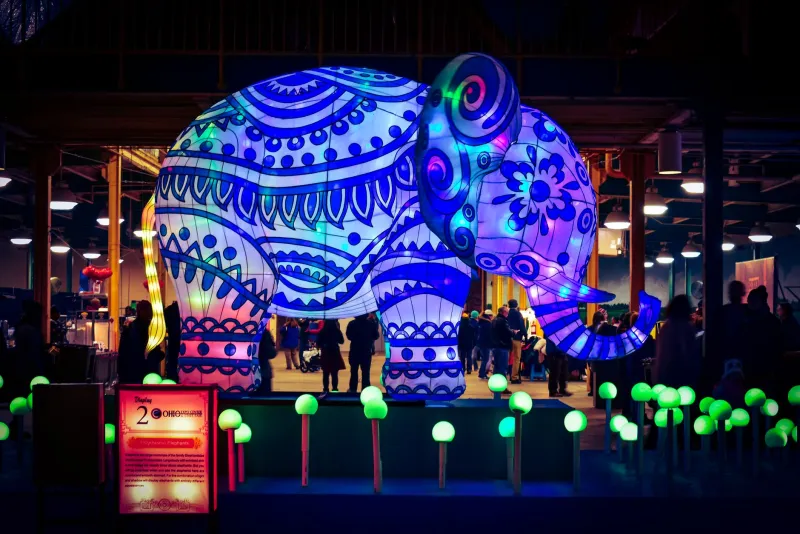
For as long as the contemporary art world has existed in its current form, access to it has been anything but democratic. The traditional gallery system — with its invitation-only openings, its quiet networks of collectors, and its geographic concentration in a handful of American cities — has functioned less as a meritocracy and more as a closed ecosystem. Talent, it turns out, has never been the primary currency. Proximity to the right people often has been.
Yuguang Art Festival is part of a broader movement that is working to change that calculus. By centering large-scale, immersive light installations in open, communal environments, festivals like Yuguang have created an entirely new exhibition architecture — one that does not require an artist to know the right gallerist, hold an MFA from a prestigious institution, or reside within driving distance of Chelsea or the Arts District in Los Angeles.
The Gallery System and Its Invisible Walls
To understand why festivals matter so profoundly to emerging artists, it helps to understand what the traditional gallery model demands of them. Breaking into a reputable gallery in the United States typically requires years of relationship-building, a demonstrated sales history, and often a geographic presence in a major metropolitan market. For artists from rural communities, first-generation college graduates entering the art world, or creators from historically underrepresented backgrounds, these requirements function as compounding barriers.
Maria Vásquez, a light sculptor from the Rio Grande Valley in Texas, describes the experience plainly. "I had work that I believed in completely. But every gallery inquiry I sent came back with either silence or a request to visit in person — which meant flying to New York or San Francisco on a budget I didn't have. The system wasn't designed with people like me in mind."
Vásquez submitted a proposal to Yuguang's open call program three years ago. Her installation — a sprawling grid of hand-formed glass vessels illuminated from within, each representing a different generation of her family's migration story — became one of the festival's most discussed works that season. Since then, she has been commissioned by two public arts organizations and featured in a national publication dedicated to emerging American artists.
"The festival gave me something no gallery application ever did," she says. "It gave me an audience before I had a résumé."
Scale as Equalizer
There is something inherently leveling about the immersive festival format. When an installation occupies thousands of square feet of open space and invites thousands of visitors to walk through it, to photograph it, to sit inside it and feel something — the work speaks entirely for itself. There is no velvet rope, no price list on the wall, no implicit social code dictating who belongs in the room.
This accessibility operates on multiple levels. Visitors from all economic backgrounds attend festivals like Yuguang, many of whom would never set foot in a conventional gallery. That expanded audience creates a kind of democratic feedback loop: artists whose work resonates with a broad public gain visibility that translates into future opportunities, regardless of whether they have ever been vetted by the institutional art world.
For artists, the open-call submission model that many immersive festivals employ is equally significant. Unlike gallery representation, which is largely granted through personal recommendation, open calls evaluate proposals on the strength of the concept and the artist's vision. The playing field, while never perfectly level, tilts meaningfully toward merit.
Building Careers Outside the Traditional Ladder
The careers being built through festival platforms are not simply alternative paths — in many cases, they are becoming the preferred path for a new generation of American artists.
Derek Okonkwo, a multidisciplinary artist based in Atlanta, had spent several years showing work in local community spaces and smaller regional exhibitions before submitting to a major light festival. His large-scale projection work, which layers archival imagery of the American South with original audio composition, was selected and ultimately became a centerpiece of that year's program.
"The exposure I got from one festival appearance exceeded everything I had accumulated in the previous five years combined," Okonkwo reflects. "And it wasn't just visibility — it was the right kind of visibility. People who saw the work understood it in the context I intended, because they were experiencing it at full scale, in the dark, with the sound surrounding them. That's not something a gallery jpeg can replicate."
His experience points to a dimension of festival exhibition that is often underappreciated: the format itself serves the work in ways that white-walled gallery spaces simply cannot. Immersive light art, by its very nature, demands an environment that amplifies rather than contains. Festivals provide that environment as a matter of course.
Institutional Attention Is Following
Perhaps the most telling indicator of the festival model's growing legitimacy is the degree to which traditional art institutions are now paying attention. Museum curators, foundation program officers, and major collectors have increasingly begun attending immersive festivals not merely as leisure activities but as scouting opportunities. The pipeline that once ran exclusively from MFA programs to gallery representation to museum acquisition is developing meaningful new tributaries.
Yuguang's own curatorial team has made a deliberate commitment to amplifying this shift. The festival's open submission process is structured to actively welcome proposals from artists who lack extensive exhibition histories, and its artist support resources — including stipends, fabrication assistance, and promotional infrastructure — are designed to reduce the financial barriers that disproportionately affect emerging creators.
"We are not interested in simply presenting established names," says a member of Yuguang's programming committee. "The most exciting work in American art right now is coming from people who have never had a proper platform. Our job is to be that platform."
What 'Making It' Means Now
The very definition of success in the art world is undergoing a quiet but significant revision. For previous generations, "making it" meant gallery representation, museum acquisition, and critical recognition from a small number of influential publications. For a growing number of artists, that definition now includes something different: the ability to place work in front of tens of thousands of people, to build a direct relationship with an audience, and to sustain a creative practice on one's own terms.
Festivals like Yuguang are central to that redefinition. They offer not just exhibition space but a complete ecosystem — community, mentorship, press attention, and the kind of lived experience that shapes an artist's trajectory in lasting ways.
Maria Vásquez puts it simply: "I didn't need a gallery to validate my work. I needed people to see it. The festival understood that. And once people saw it, everything else followed."
The democracy of access that immersive art festivals are helping to build is not yet complete. Structural inequities in the broader art world remain stubborn and deeply rooted. But in the space between darkness and light — quite literally — something is shifting. And for artists who have long been told to wait their turn at a door that was never really open to them, that shift is everything.