What People Whisper in the Glow: Five Unscripted Moments of Connection
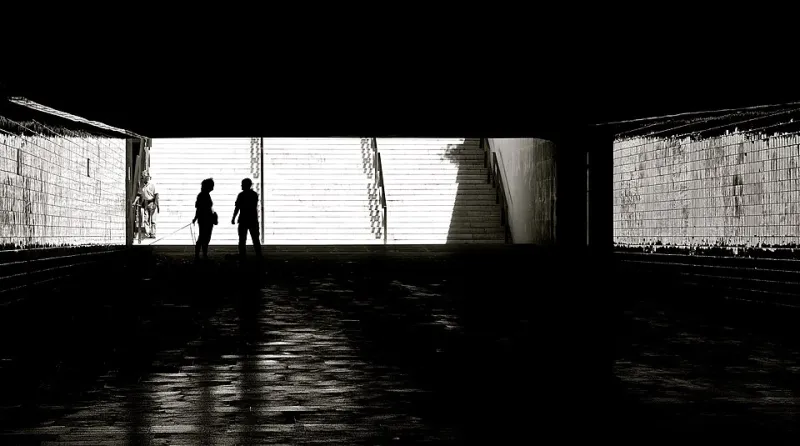
Photo: Pedro Ribeiro Simões from Lisboa, Portugal, CC BY 2.0, via Wikimedia Commons
There is a particular sound an art festival makes that no marketing team has ever captured: the murmur of people talking to each other about what they are seeing. Not lecturing. Not reading wall text aloud. Just talking — hesitantly, wonderfully, to friends and to complete strangers.
We walked the grounds one evening with notebooks and no agenda, listening for the moments when the art did what it is actually built to do. Here is what we heard.
1. The Parent Explaining Light to a Child
Near the entrance tunnel, a father crouched beside his daughter, who was watching her shadow split into three colors on the pavement.
"You're made of light too," he said. "Everything is. You just can't usually see it."
She stared at him, then at her hands, for a very long time.
Why it happens here: In a gallery, a parent becomes a docent, translating placards. Under a projection that responds to a child's movement, the parent gets to be a fellow wonderer. The art does the explaining; the parent gets to share the awe instead of managing it.
2. The Stranger Who Says What Everyone Is Thinking
Halfway through the field of suspended lanterns, a woman in a rain jacket turned to the group beside her and said, without preamble: "I needed this more than I knew."
Three strangers nodded. Nobody found this strange.
Why it happens here: Darkness is a social lubricant. Without eye contact to negotiate, people say truer things. Festivals are among the last public spaces where an American adult can be openly moved in front of others without explaining themselves.
3. The Debate Over What It Means
In front of the large-scale projection piece, two college students were having an argument of the best kind.
"It's clearly about memory. The way it keeps replaying and degrading."
"It's about the ocean. Listen to the sound design."
"Can't it be about the ocean remembering?"
They walked on together, still arguing, now friends.
Why it happens here: Museums tell you what you are looking at. Festivals mostly decline to. Ambiguity, so carefully curated out of the traditional exhibition, is the main event here — and ambiguity requires conversation to resolve, or better, to savor unresolved.
4. The Reunion That Starts Mid-Sentence
"—and I told her, I said, you have to see this one—"
Two friends, separated an hour earlier in the crowd, found each other again by the sound garden and resumed their conversation as if no time had passed, both talking at once about which piece to see next.
Why it happens here: The festival's geography creates gentle drama — separation, search, reunion — that turns a night out into a shared story. People leave with a plot, not just a photo.
5. The Question No One Answers
A boy of about ten, walking out through the final corridor of light, asked his grandfather: "Who thinks of this stuff?"
The grandfather considered it. "Somebody who needed to say it," he said.
That was the whole conversation. It was enough.
Why it happens here: The best festival art leaves a residue — a question that travels home with you. The car ride after a festival is famously quieter than the drive there. Something is still being processed.
The Common Thread
What all five moments share is a lack of script. No audio guide, no placard, no docent mediating the experience. Immersive festivals strip away the apparatus that tells audiences how to feel and, in doing so, hand the meaning-making back to the people standing in the glow. The art on the grounds is remarkable. But the conversation it starts — between parent and child, between strangers, across generations — may be the most important work on display.